Blog Against Theocracy: Terror & Disaster
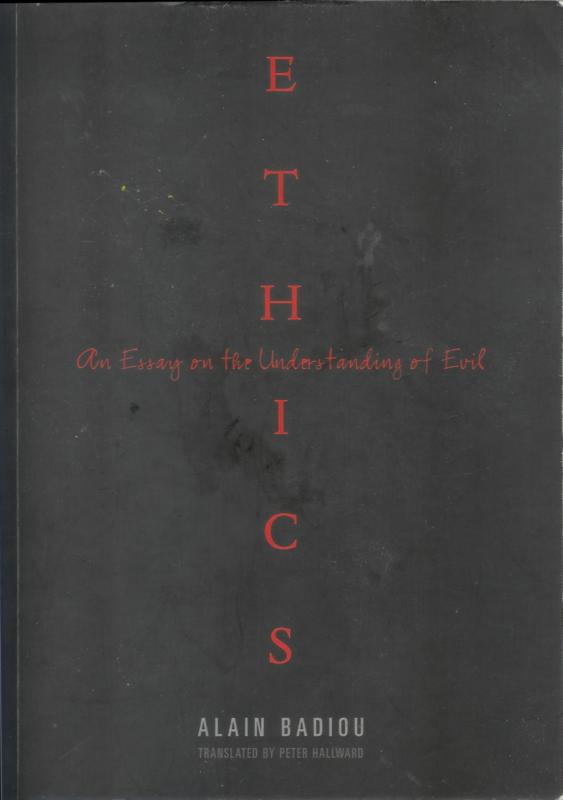
Books That Changed Me: Ethics: An Essay on the Understanding of Evil, Alain Badiou
BADIOU’S CONCEPTION OF ETHICS is about exercising one’s capacity to do good. To do so is to be more than just an animal operating on instinct alone. Badiou would say one becomes immortal in defining and propelling a truth forward in “the situation.” This ability is what makes us human, and there are no ethical truths without subjects possessed of this ability.
There is one ground rule: In order for a truth to be a truth in Badiou’s sense, it must be a universal truth. And there is one ethical obligation: fidelity to a truth; which basically boils down to: keep going!
It seems to me, that people can come to be truth subjects in different ways. Through religious faith; simply having a strong inner conviction; by engaging in reasoned thought; or in combinations of two, or all three of these — we will, ideally, find ourselves subjects in the same truth process. For instance, we might each arrive at the conclusion: murder is wrong.
But murder is an easy one. Seems pretty universal, so keep going on the not murdering thing! Because, more important than how we come to be truth subjects, is accepting the moral imperative of fidelity to that truth.
HOWEVER, no matter what processes we are subject to, we often come to different conclusions, for instance, on questions of abortion, gay marriage, environmentalism, etc.
By Badiou’s standard, truths are universal. On the other hand, simulacra masquerade as truths, and though their subjects may earnestly believe in them, they are not universal. Subjects — whether they be subjects to a truth or a simulacrum — who are not content to simply keep going, (their sole ethical duty,) but feel that they should also compel, coerce or force others to go along face the same dilemma. Though there is certainly room for evangelizing, cajoling, or proselytizing, Badiou warns:
- Imposing the power of a simulacrum is terror.* (A form of EVIL.)
- Imposing the power of a truth is disaster. (Also EVIL.)
For example: imposing the power of a simulacrum (“national belonging,” for instance, the “truth” of the greatness of a single nation, which is clearly not a universal truth but is based in ideas of “soil,” “blood,” “borders,” etc.) results in terror. And though, as we have noted, proselytizing is certainly allowed in the militant fidelity required of subjects to a truth — the totalitarian imposition of a truth, (say: a prison state that results in the incarceration of a full percent of its population and disproportionately imprisons minorities,) is disaster.
Which is to say, imposing religion — or even putting the power of the state behind certain religious values — is to flirt dangerously with EVIL. So Your Montag Blogs Against Theocracy.
* Different sense than Global War on Terror.™
CREDIT: Some sentences and phrasing in the above post have been plagiarized from Your Own Fehlleistungen. Thanks, Fehlleistungen!


 Stump Lane