Aesthetic Truth

Books That Changed Me: Towards A New Architecture, Le Corbusier
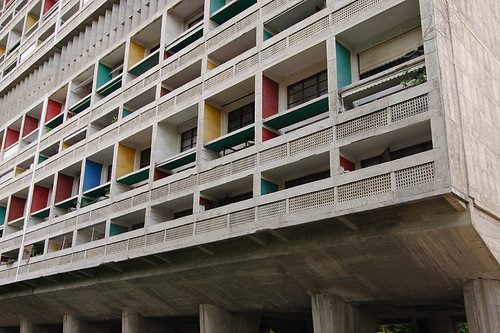
MS. MONTAG TELLS ME that there are objective aesthetic truths. This is something that I have wanted to better understand for some time. It turns out the Architect Le Corbusier (Ronchamp, Villa Savoye, Unité d’Habitation) laid it down in writing some time ago. As a bonus, he did so in a way that makes sense even to a struggling neophyte of Badiou’s ethics.
Le Corbu:
The distinction of a fine face lies in the quality of the features and in a quite special and personal value of the relationship between them. The same general type of face is the property of every individual: nose, mouth, forehead, etc., and also the same general proportion between these elements. There are millions of countenances constructed on these general lines; nevertheless all are different: there is a variation in the quality of the features and in the relationship which unites them. We say that a face is handsome when the precision of the modeling and the disposition of the features reveal proportions which we feel to be harmonious because they arouse, deep within us and beyond our senses, a resonance, a sort of sounding board which begins to vibrate. An indefinable trace of the Absolute which lies in the depths of our being.
This sounding board which vibrates in us is our criterion of harmony. This is indeed the axis on which man is organized in perfect accord with nature and probably with the universe, this axis of organization which must indeed be that on which all phenomena and all objects of nature are based; this axis leads us to assume a unity of conduct in the universe and to admit a single will behind it. The laws of physics are thus a corollary to this axis, and if we recognize (and love) science and its works, it is because one and the other force us to admit that they are prescribed by this primal will. If the results of mathematical calculation appear satisfying and harmonious to us, it is because they proceed from the axis. If, through calculation, the airplane takes on an aspect of a fish or some object of nature, it is because it has recovered the axis. If the canoe, the musical instrument, the turbine, all results of experiment and calculation, appear to us to be “organized” phenomena, that is to say as having in themselves a certain life, it is because they are based upon that axis. From this we get a possible definition of harmony, that is to say a moment of accord with the axis that lies in man, and so with the laws of the universe, —a return to universal law. This would afford an explanation of the cause of the satisfaction we experience at the sight of certain objects, a satisfaction which commands at every moment an effective unanimity.
If we are brought up short by the Parthenon, it is because a chord inside us is struck when we see it; the axis is touched.
Some of that quote evokes a sort of mysticism, but read as a description of a universal truth, (as Badiou prescribes all truths must be,) it nonetheless gets my sounding board vibrating. Having described this truth, Le Corbusier then turns to the example of the Parthenon, as he does several times throughout Towards A New Architecture in discussing the properties of good architecture.
I’m not entirely clear what that makes the Parthenon in Badiou speak. I’ve not read all the books and materials, most of which are dauntingly written above my grade level. Still, I ponder, can its existence be called a truth event? Not sure. But it is surely a ‘handsome face,’ the culmination and perfection of the aspects of architecture Le Corbusier lays out, (form, surface, plan, regulating lines,) and the proportion and relationship of those elements, but did the design and construction of the Parthenon itself bring about, out of the void*, a new concept of peoples’ experience/understanding/interaction with architecture? I dare say at least, that Le Corbusier was certainly a subject to those truths, in that he possessed a strident fidelity to the aesthetic architectural truths inherent in the Parthenon.
Le Corbusier. Towards a New Architecture. Trans. Frederick Etchells. New York, NY: Dover Publications, Inc., 1986. 203+.
* Badiou’s concept of “void” is based in set theory, so there’s a nice bit of symmetry here with Le Corbu’s natural/mathematical basis for aesthetic truth. So perhaps it makes sense that beauty can be found in purely mathematical forms. The Mandelbrot Set, for example touches the axis:

Click image for an interactive tour of the Mandelbrot set. Can this be rightly called a fractal post? A self-similar blog within a blog? Are you vibrating yet?
Continue reading below the fold for an unqualified criticism of something else altogether that Le Corbusier wrote in that book. Read more…


 Stump Lane