More On the Truth Process: Chaos
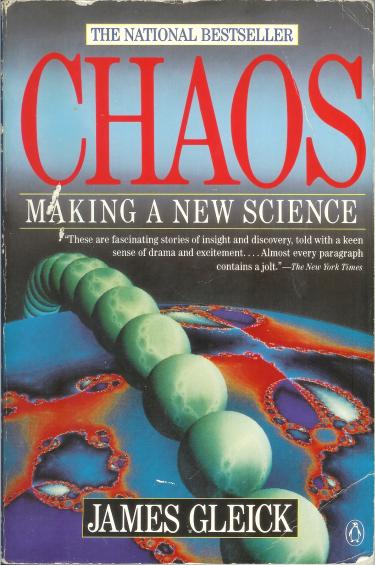
Books That Changed Me: Chaos: Making a New Science, James Gleick
IT WAS A DARK AND STORMY NIGHT. Boston, 1992. At an after-hours club, which may or may not have been an illegal operation. In a three story building of questionable structural integrity. There were the dulcet tones of techno. Trance, I think. On a video screen, moving images of fractals were being shown. It may have been a ‘Mandelbrot zoom’ though I didn’t know what one was at the time. Fehlleistungen was there. F nodded toward the video screen, then, in order to be heard over the music shouted into the space next my ear, “Chaos Theory.”
I looked dumbly at the screen, then back at F, who went on, “When you look at a Part, no matter how small, it looks the same as the Whole.”
“Sweet,” I said. I was tripping balls on vodka, cigarettes, ephedrine, and X, and thus unable to process the mind blowing shit F was trying to lay on me.
It wouldn’t be for another, what, sixteen years, after that “conversation,” more than twenty years after the book pictured above was published, before I got round to reading up on the subject.
Anyway, what I’ve learned is that I have been thinking wrong about a great many things with this whole ‘truth process’ thing. Oh, it was so clever of me, in a recent post, to leap from the architect Le Corbusier’s “[human] criterion of harmony,” (in terms of aesthetics,) to the Mandelbrot set, which is featured heavily in Chaos. But, the more I think about these things, the more it seems a strange connection to make. Especially in thinking more deeply about the difference between philosophical truths, which do not have any context in which to exist without ‘truth subjects,’ — human minds to think about them — and scientific or mathematical truths, (natural truths?) which, I would argue, exist independent of human minds. In other words, when a tree falls in the woods, vibrations result, which would be observed as sound if someone were there to ‘hear’ them.
But wait. Le Corbusier described his criterion of harmony as the “axis of organization which must indeed be that on which all phenomena and all objects of nature are based.” Which is certainly the sense one gets of the science of chaos described in Gleick’s book. So, aesthetic philosophical truth, at least to hear Le Corbu tell it, may be based in our innate sense of chaos theory. And Your Montag’s misfiring synapses are vindicated!
In explaining patterns and forms found in nature which seem at first random or chaotic, but when considered in the proper context, are found to conform to that axis of organization, with the help of Michael Barnsley, Gleick also describes what I’ve taken to calling ‘natural truth’:
“…when we go into a new room, our eyes dance around it in some order which we might as well take to be random, and we get a good idea of the room. The room is just what it is. The object exists regardless of what I happen to do.”
The Mandelbrot Set, in the same way, exists. It existed before Peitgen and Richter began turning it into an art form, before Hubbard and Douady understood its mathematical essence, even before Mandelbrot discovered it. It existed as soon as science created a context — a framework of complex numbers and a notion of iterated functions. Then it waited to be unveiled. Or perhaps it existed even earlier, as soon as nature began organizing itself by means of simple physical laws, repeated with infinite patience and everywhere the same.
There was one other gift this book gave me, in this nexus point in between Le Corbusier and Mandelbrot that I have been inhabiting. See, I love it when intellectuals fight, with their gutting insults and arrogant senses of infallibility. That shit’s entertaining, yo. Under the cut, we witness an intellectual slap fight… across time. Read more…


 Stump Lane