Spectacular Time
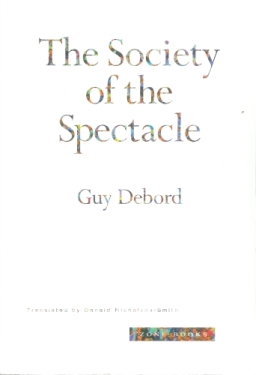
Books that Changed Me: The Society of the Spectacle, Guy Debord.
Voices From The Grave! Guy Debord changed my life. Well, he at least provided a framework and language to think about certain truths I’d had some nagging sense of, yet until now, would have struggled to express. Though the edition pictured above is the book I read, for cutting and pasting purposes, the excerpts in the article below come from a different translation that I found online.
WHAT IS the spectacle? Debord puts forth the proposition that we people of the modern age do not directly live, but rather experience a representation of life through an endless succession of spectacles.
In all of its particular manifestations — news, propaganda, advertising, entertainment — the spectacle represents the dominant model of life. It is the omnipresent affirmation of the choices that have already been made in the sphere of production and in the consumption implied by that production. In both form and content the spectacle serves as a total justification of the conditions and goals of the existing system. [Debord, #6]
That sense of dissonance we experience, in quiet moments of clarity, between the world we plainly perceive, and the world as it is presented to us, is born of our alienation from an unreal version of ourselves which is a construct of our all-too-real societal (spectacular) institutions.
Spectacular society is uncompromisingly divided into a small elite ruling class and everybody else, whose value stems from their productivity. The spectacle’s greatest strength is in it’s ability to create and perpetuate an image, an alternate version, representing the “truth” of these opposing classes.
Wait, when the fuck did all of this happen?
The historical moment when Bolshevism triumphed for itself in Russia and social democracy fought victoriously for the old world marks the inauguration of the state of affairs that is at the heart of the modern spectacle’s domination: the representation of the working class has become an enemy of the working class. [Debord, #100]
This representation of the working class is still at work today. It could be witnessed recently, when we saw the vilification of autoworkers as they made efforts to ensure the pensions and retirement health benefits owed them as a term of their employment would continue to be honored, even as the auto companies were facing bankruptcy. It can be seen in the vilification of migrant workers, even as they harvest our food! It cannot be said that that work isn’t valuable to society, but these are some of the most hated people in this country.
This sort of domination through false representation and alienation isn’t limited to workers. The portrayal of women, minorities, young people, the handicapped, in no way reflects the true nature of particular individuals or their aspirations. The spectacle thrives by creating these groups and categorizing people by association, and then championing or dispatching whatever group’s concerns as determined by political utility.
The spectacle is a potent servant of power.
Debord’s chapter 6, Spectacular Time is one that really sings. Especially to one experiencing the constant sense of loss brought on by an obsessive preoccupation with the inexorable passage of time. Read more…


 Stump Lane